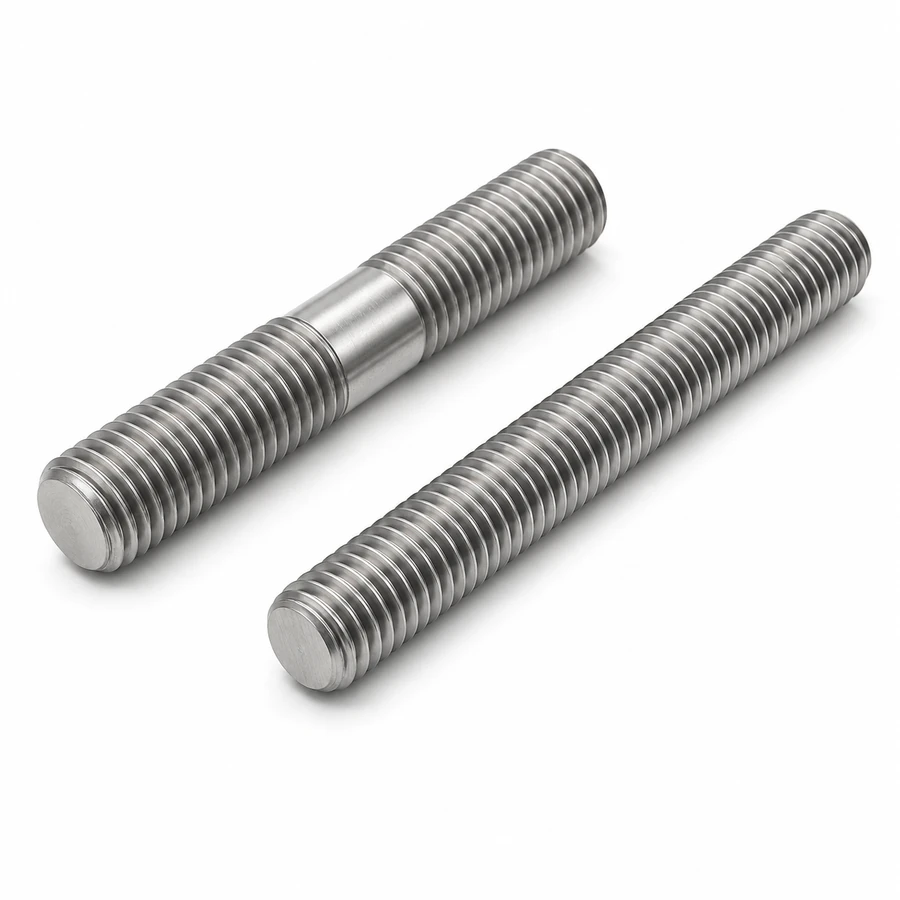
What is the difference between a double-end stud and a tap-end stud?
A double-end stud typically has threaded ends at both sides with a possible plain center section. A tap-end stud may have different thread lengths, pitches or fits at each end, where one end (the tap end) is designed for a tapped hole and the other end for a nut. They are not interchangeable. Buyers should confirm the specific stud type, thread configuration and end application per their drawing or BOM.
What is the difference between a double-end stud and a stud bolt?
A double-end stud has threaded ends with a plain center section. A stud bolt is typically fully threaded or has threaded ends without a prominent plain center. The dimensional configuration depends on the applicable standard or buyer drawing. Buyers should confirm the specific product type per their RFQ.
What is the difference between a double-end stud and a fully threaded rod?
A double-end stud has threaded sections at the ends and may have a plain center shank. A fully threaded rod has continuous threads along its entire length. They serve different applications and are not interchangeable. Buyers should confirm the product type per their drawing or standard.
What is the difference between a double-end stud and an anchor rod?
A double-end stud is a general-purpose stud with threaded ends for nut or tapped-hole engagement. Anchor rods are typically used with adhesive or cast-in-place for structural anchoring applications. They serve different applications and are not interchangeable.
What is the difference between a double-end stud and a headed bolt?
A double-end stud has no head; it has threaded ends at both sides. A headed bolt has a formed head at one end and a threaded section at the other. They use different tightening mechanisms and are not interchangeable. Buyers should confirm the product type per their drawing or application.
Can a double-end stud be specified by overall length and diameter alone?
No. A double-end stud cannot be specified by overall length and diameter alone. The buyer must also specify thread length at end A, thread length at end B, plain center length, thread pitch or TPI, thread tolerance, same or different thread at both ends, end chamfer, and applicable standard or drawing. Two studs with the same overall length and diameter may have different thread configurations and are not interchangeable.
What thread configurations are available for double-end studs?
Double-end studs may have same threads at both ends, different threads at each end, same or different thread pitches, right-hand or left-hand threads, and various thread tolerances. The thread configuration must be specified per the buyer's drawing, BOM or applicable standard.
What information should buyers provide for a double-end stud RFQ?
Buyers should provide product type, standard or drawing, metric or inch thread, diameter, thread pitch or TPI, overall length, thread length at end A, thread length at end B, plain center length, same or different thread at both ends, thread tolerance, right-hand or left-hand thread, end chamfer, material, property class or grade, surface finish, matching nut requirements, tapped-hole requirements, quantity by SKU, packing, thread protection, inspection documents and destination.
Can metric and inch threads be mixed on the same stud?
Metric and inch threads should not be mixed on the same stud unless explicitly specified by the buyer's drawing or project specification. Any mixed-thread configuration must be confirmed during manual RFQ review.
Does coating affect thread fit for double-end studs?
Yes. Coating thickness may affect thread fit, pitch diameter and assembly interference. Coating requirements must be reviewed together with the thread tolerance, matching nut or tapped-hole requirements. The final specification should be confirmed according to the buyer's drawing, BOM, or applicable standard.
What materials and property classes are commonly used?
Common materials include carbon steel in property classes 4.8, 5.8, 8.8, 10.9 and 12.9, and stainless steel in A2-70, A2-80, A4-70 and A4-80. Alloy steel and non-standard materials are also possible per buyer specification. The material and property class should be confirmed per the buyer's drawing, BOM, or applicable standard.
Are all double-end studs supplied with nuts?
No. Double-end studs may be ordered with or without matching nuts depending on the application and buyer requirements. If nuts are required, the nut standard, grade, material, finish and thread configuration should be specified in the RFQ.
What surface finishes are available for double-end studs?
Common finishes include plain (oiled), zinc plated, hot-dip galvanized, phosphate (manganese or zinc), Dacromet, Geomet and other coatings per buyer specification. The finish selection depends on the service environment, thread tolerance and nut compatibility. No fixed corrosion resistance rating should be assumed without project-specific confirmation.
Can double-end studs be included in a mixed fastener order?
Yes. Mixed orders can be reviewed manually when stud type, standard or drawing, thread configuration, dimensions, material, grade, finish, quantity, packing and inspection requirements are clear for each SKU.
What inspection documents can be discussed?
Depending on the item and buyer requirements, documents may include dimensional reports, material test certificates, mechanical property test reports, coating thickness reports, magnetic particle or dye penetrant inspection reports where applicable, packing lists and pre-shipment photos.
What affects the lead time for a double-end stud order?
Lead time depends on material availability, diameter, overall length, thread configuration, property class, heat treatment if applicable, coating, quantity, packing requirements, required documentation and inspection requirements. Final lead time is confirmed after RFQ review.
Can double-end studs be made to customer drawing?
Yes. Double-end studs can be made to the buyer's drawing, including non-standard dimensions, thread configurations, materials, finishes and tolerances. The drawing or BOM should define all critical dimensions, thread specifications and acceptance criteria.
<
Can you review an RFQ that uses inch dimensions and convert it to metric references?
Yes. Reference conversions can be provided, but metric and inch products are not automatically interchangeable. The original thread system, pitch or TPI, dimensions, grade, matching components and applicable standard must remain part of the RFQ review.
/div>
Send Double-End Stud RFQ for Manual Review
To request a quotation for double-end studs, double-ended stud bolts, tap-end studs, equal-end or unequal-end studs, or custom studs made to drawing, prepare your RFQ using the checklist above and send it through our contact page. Prices, MOQ, packing, documentation, and lead time are confirmed after manual RFQ review. Final specifications should be confirmed according to the buyer's drawing, BOM, applicable standard, sample, assembly conditions, or RFQ requirements. Final lead time is confirmed after RFQ review.
Send RFQ