
- Metric thread (ISO coarse or fine pitch)
- UNC (Unified Coarse) thread
- UNF (Unified Fine) thread
- 8UN thread series where specified
- Coarse and fine pitch
- Right-hand and left-hand thread
- Overall length
- Threaded length at each end
- Plain shank length for double-end studs
- End chamfer
- End point
- Cut end
- Burr removal
- Thread tolerance or fit class
- Nut fit confirmation
- Coating allowance
- Length tolerance
- Straightness requirement
- Cut-to-length requirements
Fastener product knowledge
Stud Bolts, Double-End Studs and Threaded Rods
Studs and threaded rods from China are widely sourced for flange connections, pipe supports, structural anchoring, machinery assembly, and general industrial threaded fastening applications. Common types include fully threaded rods, stud bolts, double-end studs, tap-end studs, flange connection studs, anchor rods, and cut-to-length threaded rods. Buyers should confirm product type, standard or drawing, diameter, thread pitch or TPI, overall length, threaded length at each end, plain centre length where applicable, material and grade, surface finish, and matching nut requirements before quotation. Standard references may include DIN 976, ISO 898, ASTM A193, ASTM A307, ASTM F1554, or project-specific drawings. We support sourcing communication for studs and threaded rods with matching nuts and washers, mixed SKU orders, DIN / ISO / ASTM requirement review, and Hebei / Yongnian fastener cluster sourcing where applicable. Prices, MOQ, delivery lead time, packing details, and documentation are confirmed after manual RFQ review. Product images are representative only; final specifications should be confirmed by buyer drawings, standards, samples, or purchase lists.
Direct Answer for Buyers
Fully threaded rods, stud bolts, double-end studs, tap-end studs, flange connection studs, anchor rods and cut-to-length threaded rods are different products and cannot be identified from a product photo alone.
To prepare a studs and threaded rods RFQ, buyers should confirm at least:
- Original buyer specification before conversion
- Product type
- Standard or drawing
- Metric or inch thread
- Thread diameter
- Thread pitch or threads per inch
- Overall length
- Threaded length at each end
- Plain centre length where applicable
- Thread direction
- Thread tolerance or fit
- Material
- Property class or ASTM grade
- Surface finish
- Matching nut requirements
- End condition
- Quantity by SKU
- Packing
- Inspection documents
- Application
- Destination
Prices, MOQ, packing, documentation, and lead time are confirmed after manual RFQ review.
Final specifications should be confirmed according to the buyer's drawing, BOM, project standard, sample or RFQ requirements.
Products with different diameters, lengths, thread pitches, grades, materials or finishes should be listed as separate SKUs.
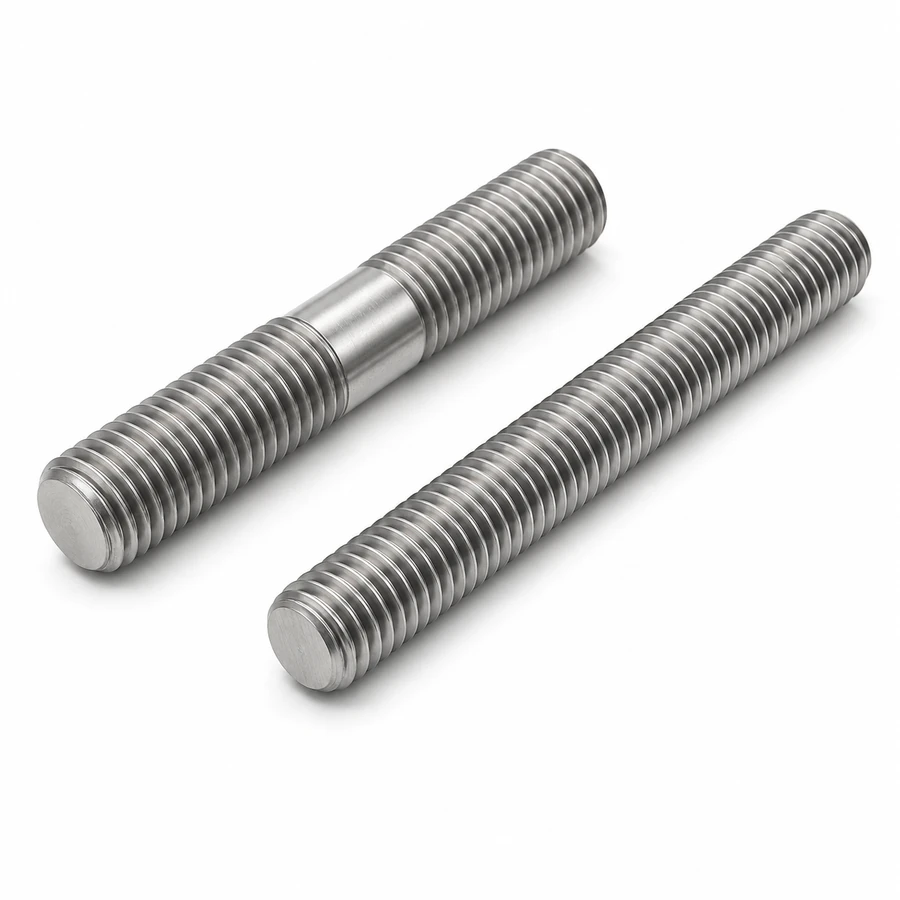
Product images are representative category references only. Final specifications should be confirmed by buyer drawings, standards, samples, or purchase lists.
Product Types and Applications
Use this table as a starting point for RFQ preparation. Stud bolts, double-end studs and fully threaded rods are different products and should not be treated as interchangeable based on appearance alone. Final specifications should come from buyer documents.
| Product Type | Typical Application | RFQ Detail to Confirm | Buyer Note |
|---|---|---|---|
| Fully threaded rods | Support, hanger, mechanical connection and general fastening | Diameter, length, pitch, grade, finish, cutting tolerance | Confirm if full length threading is acceptable. Cutting and chamfer requirements must be specified. |
| Stud bolts | Flange, pipe and pressure equipment connections per specification | Standard, grade, length measurement, matching nut, project documents | Length measurement method depends on applicable standard. Not interchangeable with fully threaded rods. |
| Double-end studs | Two-end threaded fastening with plain centre shank | Thread length both ends, plain centre length, overall length | Thread length at each end must be specified separately. Left-hand thread to be confirmed. |
| Tap-end studs | One end tapped into hole, other end receives nut | Thread form at each end, pitch, fit, thread length, engagement length | Both ends may have different threads. Must be specified in drawing or RFQ. |
| Flange connection studs | Flange assemblies per project specification | ASTM grade, thread series, matching nut, project code | ASTM grade and applicable project code must be confirmed. |
| Anchor rods | Cast-in or post-installed anchoring systems | Material grade, thread spec, mating system, project drawing | Not the same product as wedge anchors or sleeve anchors. |
| Cut-to-length threaded rods | Cut from long rods to buyer's required length | Length tolerance, end chamfer, burr removal, nut run-on | End condition and nut fit after cutting must be confirmed. |
| Custom studs made to drawing | Non-standard or project-specific designs | Drawing, sample, project standard, applicable specification | Final dimensions, material and finish per buyer documents. |
Important: Stud bolts, double-end studs and fully threaded rods are not interchangeable because they appear similar. Anchor rods and wedge anchors are different products. Product images are reference only and do not replace complete specifications.
Common Standards and Grade References
The following references apply to specific product types, materials, grades and project contexts. Not every stud or threaded rod automatically complies with every reference below. Buyers should confirm which standard and grade applies to their specific product and project requirements.
| Standard / Grade | Common Scope | Typical Buyer Use | Important Limitation |
|---|---|---|---|
| DIN 976-1 | Metric stud bolts and threaded products | When buyer specification references DIN 976-1 | Must confirm diameter, pitch, length, material grade and finish. DIN reference alone does not define complete specification. |
| ISO 898-1 | Mechanical properties of carbon steel and alloy steel bolts, screws and studs | When property class (e.g. 8.8, 10.9) is specified | Applicable to specific size and grade ranges. Property class cannot be determined from appearance. |
| ISO 3506-1 | Mechanical properties of corrosion-resistant stainless steel fasteners | When stainless steel grade is specified | Must confirm stainless steel group and property class. A2 and A4 are not interchangeable. |
| ASTM A193 / A193M | Alloy and stainless steel bolting for high-temperature or high-pressure service | When Grade B7, B8 or B8M is specified | Not all stud bolts automatically comply with ASTM A193. Must confirm exact grade, size range and applicable supplement. |
| ASTM A320 / A320M | Alloy and stainless steel bolting for low-temperature service | When Grade L7, L7M, B8 or B8M Class 1 or 2 is specified | Not automatically applicable without project requirement for low-temperature service. |
| ASTM A307 | Carbon steel bolts and studs, Grade A and Grade B | When ASTM A307 Grade A or B is specified | Must confirm grade and application. Not suitable for all high-strength applications. |
| ASTM F1554 | Anchor bolts, anchor rods for structural applications | When anchor rod specification references ASTM F1554 Grades 36, 55 or 105 | Applies to anchor rods only. Does not apply to wedge anchors or sleeve anchors. |
| ASTM A354 | Quenched and tempered alloy steel bolts, studs and threaded fasteners | When Grade BC or BD is specified | Must confirm specific grade and project requirements. |
| Buyer drawing or project specification | Non-standard, custom or project-specific designs | When standard products do not match project requirements | Final dimensions, material, grade, finish and testing per buyer documents. |
Important: Standards and grades are not interchangeable solely because dimensions appear similar. Material, mechanical properties, thread form, nut compatibility, coating and project requirements must be confirmed. Do not claim compliance with any standard without confirming the specific product, material, grade, dimensions and applicable project requirements.
Thread and Dimensional Considerations
Thread and dimension parameters determine whether a stud or threaded rod can meet the buyer's application requirements. Several parameters must be reviewed together.
Important: Overall length and threaded length are not the same parameter. Double-end studs require confirmed thread length at both ends separately. Tap-end studs may have different thread pitch or fit at each end. Metric and inch threads cannot be mixed. Coating thickness affects thread fit and must be reviewed with matching nuts. Cut-to-length threaded rods require end chamfer, burr removal and nut run-on confirmation. Diameter and overall length alone are not sufficient to define a stud or threaded rod.
Materials and Surface Finish Directions
Material, grade, finish, matching nuts and service environment should be reviewed together. The final choice depends on project requirements and buyer specifications.
| Material / Finish | Typical Direction | RFQ Detail to Confirm | Buyer Note |
|---|---|---|---|
| Carbon steel | General industrial connections per buyer specification | Grade, property class, finish, service condition | Not suitable for all corrosive or high-temperature environments. |
| Alloy steel | Higher strength or temperature requirement per project standard | ASTM grade, property class, applicable project standard | Grade and heat treatment must be specified. |
| Stainless steel A2 / 304 | General corrosion-resistant applications | Grade confirmation, application environment, property class | Not automatically suitable for all corrosive environments including marine exposure. |
| Stainless steel A4 / 316 | Higher corrosion resistance environment | Grade confirmation, project standard, exposure condition | Final choice depends on project environment and buyer standard. |
| Plain / black finish | Industrial applications per buyer specification | Finish appearance, oil coating if required, rust prevention | Plain finish has no corrosion protection. |
| Zinc plated | General corrosion protection per buyer specification | Coating colour, thickness, thread fit, corrosion requirement | Thread fit after plating must be confirmed with nuts. |
| Hot-dip galvanized | Outdoor or high-corrosion environment per project specification | Coating thickness, thread fit, nut oversize tapping, assembly test | Nuts are tapped oversize to accommodate coating. Thread fit and assembly must be confirmed. |
| Zinc flake coating | Corrosion and friction performance per buyer specification | Coating system, friction class, test requirement | Coating system and performance requirements must be specified. |
| PTFE or fluoropolymer coating | Buyer-specific lubrication or corrosion requirements | Coating type, colour, thickness, friction requirement, reference standard | Only discussed when buyer explicitly specifies. No brand or performance guaranteed without project information. |
| Buyer-specified special material or coating | Project-specific or non-standard requirements | Project standard, drawing, RFQ specification | Final confirmation per buyer documents. |
Important: Material, grade, finish, matching nuts and service environment should be reviewed together. No general guarantee about outdoor service life, salt spray hours, friction coefficient or corrosion resistance can be provided without project-specific information.
Packing, Handling and Shipment Considerations
Long threaded rods, heavy stud bundles and mixed-length orders create packing and handling risks. These must be discussed in the RFQ stage rather than after production.
- Rod length
- Bundle weight
- Carton weight
- Wooden case or pallet requirement
- End protection
- Thread protection
- Moisture protection
- Rust prevention
- Mixed length identification
- SKU labels
- Heat number or batch identification where required
- Matching nuts packed together or separately
- Container loading
- Manual handling limits
- Long cargo handling
- Export packing
Important: Long threaded rods should not be packed in ordinary small cartons. Different lengths, grades, materials and finishes must be clearly separated. Thread end damage, bending and mix-up during transport must be avoided. Wooden cases, pallets, steel strapping and rust prevention requirements must be confirmed in the RFQ. Final packing method depends on length, weight, transport method and buyer requirements.
Studs and Threaded Rods RFQ Checklist
Use this checklist when preparing a studs and threaded rods RFQ. Different diameters, lengths, thread pitches, grades, materials, finishes and product types must be separated into individual SKU lines.
- Original buyer specification before conversion
- Product type
- Standard
- Drawing number
- Metric or inch thread
- Diameter
- Thread pitch or TPI
- Overall length
- Threaded length
- Plain centre length
- Right-hand or left-hand thread
- Thread tolerance
- End condition
- Chamfer requirement
- Length tolerance
- Straightness requirement
- Material
- Property class
- ASTM grade
- Stainless steel grade
- Surface finish
- Coating requirement
- Matching nut standard and grade
- Matching washer requirement
- Application
- Service temperature where applicable
- Quantity by SKU
- Packing quantity
- Bundle or carton weight
- Wooden case or pallet
- Label requirements
- Batch or heat identification
- Inspection document requirements
- Destination country or port
- Drawing, BOM, sample or project specification
Different diameters, lengths, thread pitches, grades, materials, finishes and product types must be separated into individual SKU lines.
Common Procurement Mistakes
- Calling every threaded product a "threaded rod".
- Confusing stud bolts with fully threaded rods.
- Confusing anchor rods with expansion anchors.
- Quoting only diameter and length.
- Forgetting thread pitch or TPI.
- Mixing metric and inch threads.
- Not specifying the thread length at each end.
- Not defining the plain centre length.
- Assuming both ends of a tap-end stud use the same thread.
- Ignoring thread tolerance and nut fit.
- Selecting a grade without confirming the applicable standard.
- Assuming DIN, ISO and ASTM products are automatically interchangeable.
- Forgetting matching nut grade and finish.
- Ignoring coating effects on thread fit.
- Not defining cut-end, chamfer or burr requirements.
- Ignoring straightness on long threaded rods.
- Using ordinary cartons for long or heavy rods without confirming handling.
- Mixing different grades or lengths in one unclear RFQ line.
- Approving production only from a representative image.
- Requesting MTC or inspection documents only after production.
Product-Level FAQ
Short answers for buyers preparing technical studs and threaded rods RFQs.
What is the difference between a stud bolt and a threaded rod?
Stud bolts are typically used for flange and pressure equipment connections with defined thread lengths, materials, and grades per standards like ASTM A193 or DIN 976. Threaded rods are generally fully threaded along the entire length and are used for support, hanger, and general fastening applications. They are determined by the buyer's specification, not by appearance.
What is the difference between double-end studs and tap-end studs?
Double-end studs have threaded portions at both ends with a plain shank in the middle. Tap-end studs have one end designed to be screwed into a tapped hole while the other end receives a nut. Tap-end studs may have different thread pitches or lengths at each end and must be specified accordingly.
What information should buyers provide for a threaded rod RFQ?
Buyers should provide product type, standard or drawing, diameter, thread pitch or TPI, overall length, threaded length, material, grade, surface finish, matching nut requirements, quantity, packing, and inspection document requirements.
How should stud bolt length be measured?
Stud bolt length measurement depends on the standard. DIN and ISO studs may measure overall length differently from ASTM designs. The measuring method should be confirmed against the applicable standard or buyer drawing.
Why must buyers specify thread pitch or TPI?
Without thread pitch or TPI, the thread form cannot be determined. Different thread pitches affect nut fit, load distribution and application suitability. Diameter alone is insufficient.
Can metric and inch threaded products be substituted?
No. Metric threads (millimetre pitch) and inch threads (TPI) are different thread systems and cannot be substituted without changing the mating nut and application design.
Can DIN, ISO and ASTM studs be treated as interchangeable?
No. DIN, ISO and ASTM standards define different dimensional, material and property requirements. Products manufactured to different standards are not interchangeable unless specifically validated by the buyer's project specification.
What grades are commonly requested for stud bolts?
Common grade references include ASTM A193 B7, B8, B8M, ASTM A320 L7, L7M, ASTM A307 Grade A or Grade B, and ISO property classes such as 8.8 and 10.9. The applicable grade depends on the standard, material, service temperature, and project specification.
Why must matching nut grade and thread fit be confirmed?
Thread fit between studs and nuts must be compatible in pitch, tolerance, and coating allowance. Nut grade must match the stud grade and standard to ensure proper assembly and load performance.
How does hot-dip galvanizing affect threaded rods and nuts?
Hot-dip galvanizing adds coating thickness that affects thread fit. Nuts are typically tapped oversize after galvanising to accommodate the coating. Thread fit, nut grade and coating thickness must be confirmed together before production.
What packing is suitable for long threaded rods?
Long threaded rods should not be packed in ordinary small cartons. Wooden cases, steel strapping, end protectors, moisture protection and bundle weight limits must be confirmed in the RFQ. Packing method depends on length, weight, and transport method.
Can stud bolts and threaded rods be included in one mixed order?
Yes. Mixed orders can be reviewed manually when SKU data, diameters, lengths, grades, materials, finishes, quantities, packing, and inspection requirements are clear for each product type.
What documents can be discussed before shipment?
Depending on the item and buyer requirements, documents may include dimensional inspection reports, material test certificates (MTC), coating thickness reports, thread gauge checks, packing lists, and pre-shipment photos.
What affects the lead time for a mixed studs and threaded rods order?
Lead time depends on material availability, processing complexity (threading, heat treatment, coating), quantity, packing requirements, and inspection requirements. Final lead time is confirmed after RFQ review.
Can you review an RFQ that uses inch dimensions and convert it to metric references?
Yes. Reference conversions can be provided, but metric and inch products are not automatically interchangeable. The original thread system, pitch or TPI, dimensions, grade, matching components and applicable standard must remain part of the RFQ review.
Related Sourcing Links
Use these pages with the studs and threaded rods reference when preparing a buyer RFQ or mixed fastener list.
Send Studs and Threaded Rods RFQ for Manual Review
Share product types, drawings, standards, diameters, lengths, grades, materials, finishes, packing expectations, and inspection document needs for manual review.
Send RFQEmail: xyan060816@gmail.com