Fastener product knowledge

Wedge Anchors, Concrete Expansion Anchors and Through-Bolt Anchors

Wedge anchors from China are commonly sourced for fastening fixtures to solid concrete base materials specified by the buyer. Common types include concrete wedge anchors, expansion anchors, through-bolt anchors, carbon steel wedge anchors, stainless steel wedge anchors, zinc-plated wedge anchors, heavy-duty concrete anchors, and metric and inch wedge anchors. Buyers should confirm anchor type, standard or evaluation reference, base material, concrete strength, cracked or uncracked concrete requirement, diameter, overall length, effective embedment depth, fixture thickness, hole diameter, hole depth, edge distance, anchor spacing, load direction, material, surface finish, nut and washer configuration, and installation torque requirement before quotation. Standard and evaluation references may include EAD for mechanical fasteners in concrete, ASTM E488/E488M test method reference, ETA references, ICC-ES evaluation reports and project-specific drawings. We support sourcing communication for wedge anchors, mixed SKU fastener orders, anchor specification review, and Hebei / Yongnian fastener cluster sourcing. Prices, MOQ, delivery lead time, packing details, and inspection documents are confirmed after manual RFQ review. Product images are representative only; final specifications should be confirmed by buyer drawings, standards, samples, or purchase lists.

Wedge Anchor Category Reference

Wedge anchors are used across structural concrete, infrastructure, machinery anchoring, equipment mounting, railings, and general concrete fastening applications. Wedge anchors are post-installed mechanical expansion anchors designed for solid concrete base materials. They are not automatically suitable for brick, hollow block or unknown base materials. Product images are representative category references only. Final specifications should be confirmed by buyer drawings, standards, samples, or purchase lists.

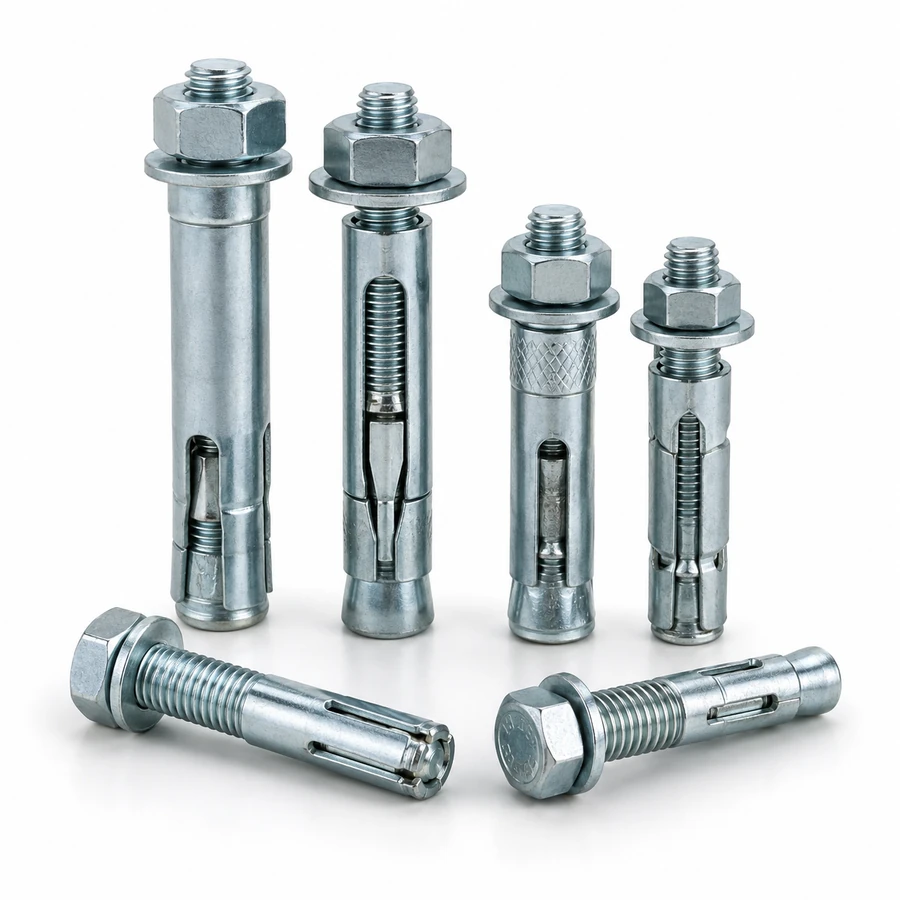
Wedge anchors for concrete fastening in multiple sizes, materials and finishes

Product images are representative category references only. Final specifications should be confirmed by buyer drawings, standards, samples, or purchase lists.

Direct Answer for Buyers

Buyers cannot specify only "wedge anchor", a single diameter, or a product photo, because wedge anchors differ from the following products:

  • Sleeve anchors — use an expandable sleeve around the bolt body; different expansion mechanism and load-transfer characteristics
  • Drop-in anchors — internally threaded flush anchors set with a setting tool; different installation method
  • Concrete screws — cut their own thread into concrete; different holding principle
  • Chemical anchors — use adhesive resin to bond the anchor to concrete; different bonding principle
  • Cast-in anchor bolts — placed in wet concrete before pouring; different installation stage and load-transfer mechanism
  • Anchor rods — threaded rods used with adhesive or in cast-in applications; different product category

Wedge anchors are post-installed mechanical expansion anchors designed for solid concrete. They are not automatically suitable for brick, hollow block or unknown base materials. The final specification depends on the buyer's drawing, structural project specification, base material conditions and application.

To prepare a wedge anchor RFQ, buyers should confirm at least:

  • Anchor type
  • Standard, drawing or evaluation reference
  • Base material
  • Concrete strength or project specification
  • Cracked or uncracked concrete requirement
  • Diameter
  • Overall length
  • Effective embedment depth
  • Fixture thickness
  • Hole diameter
  • Hole depth
  • Edge distance
  • Anchor spacing
  • Load direction
  • Material
  • Surface finish
  • Nut and washer configuration
  • Installation torque requirement
  • Application
  • Quantity by SKU
  • Packing
  • Inspection documents
  • Required ETA, ESR or project documentation
  • Destination

Prices, MOQ, packing, documentation, and lead time are confirmed after manual RFQ review.

Final specifications should be confirmed according to the buyer's drawing, BOM, structural project specification, installation conditions, or RFQ requirements.

Structural anchor selection and installation requirements must be confirmed by the buyer's qualified engineer or applicable project documentation.

Wedge Anchor Types and Applications

Use this table as a starting point for RFQ preparation. Different wedge anchor types serve different applications and are not interchangeable solely because the diameter appears similar.

Anchor TypeExpansion PrincipleTypical ApplicationRFQ Detail to Confirm
Concrete wedge anchorsWedge clip expands against concrete wall when nut is tightenedFastening structural and non-structural fixtures to solid concreteDiameter, length, embedment, material, finish, nut and washer, evaluation reference
Through-bolt anchorsThrough-bolt design with expansion clip; bolt passes through fixtureHeavy-duty concrete anchoring where through-fixing is requiredDiameter, length, embedment, fixture thickness, material, finish, evaluation reference
Carbon steel wedge anchorsWedge expansion with carbon steel bodyGeneral indoor concrete fastening per buyer specificationStandard, diameter, length, material grade, finish, application environment
Stainless steel wedge anchorsWedge expansion with stainless steel bodyCorrosion-resistant concrete fastening per buyer specificationStandard, diameter, length, material grade (A2/A4), finish, application environment
Zinc-plated wedge anchorsWedge expansion with zinc-plated carbon steel bodyGeneral corrosion-resistant concrete fasteningStandard, diameter, length, zinc coating specification, finish, application environment
Heavy-duty concrete anchorsWedge or expansion mechanism for higher load applications per buyer specificationStructural or heavy equipment anchoring per project requirementsStandard, evaluation reference, diameter, embedment, material, finish, load requirement
Metric wedge anchorsWedge expansion in metric dimensionsApplications specifying metric dimensionsStandard, metric diameter, length, embedment, material, finish
Inch wedge anchorsWedge expansion in inch dimensionsApplications specifying inch dimensionsStandard, inch diameter, length, embedment, material, finish
Custom wedge anchors made to drawingPer buyer drawing or project specificationNon-standard dimensions, material or special requirementsDrawing, BOM, dimensions, material, finish, evaluation requirements

Important: Wedge anchors and sleeve anchors are not the same product type. They use different expansion mechanisms and have different load characteristics. Product images are for identification reference only.

Standards, Testing and Evaluation References

These references are commonly requested in buyer RFQs and project documents. They are not final product approval or compliance statements. Evaluation reports, approvals and load data are product-specific, size-specific and installation-specific. Standard versions, full scope and exact requirements should be confirmed during manual RFQ review.

ReferenceCommon ScopeTypical RFQ UseImportant Limitation
EAD (European Assessment Document) for mechanical fasteners for use in concreteAssessment framework for mechanical anchors in concrete — commonly referenced in buyer RFQsSubject to confirmation during manual RFQ review — confirm product-specific ETA and applicabilityEAD is an assessment framework, not a product approval. Individual products must have their own ETA.
ASTM E488/E488MTest method for static and seismic tension and shear testing of anchors in concrete — commonly referenced in buyer RFQsSubject to confirmation during manual RFQ review — confirm test applicability and product-specific resultsASTM E488 is a test method, not a product approval. Test results are product-specific and cannot be borrowed from other products.
ETA (European Technical Assessment)Product-specific technical assessment for construction products — commonly referenced in buyer RFQsSubject to confirmation during manual RFQ review — confirm the specific ETA number, product and size rangeETA is product-specific and size-specific. Not all wedge anchors carry an ETA. One product's ETA cannot be applied to another product.
ICC-ES evaluation reports (ESR)Product-specific evaluation reports for code compliance — commonly referenced in buyer RFQsSubject to confirmation during manual RFQ review — confirm the specific ESR number, product and size rangeESR is product-specific and size-specific. Not all wedge anchors have an ICC-ES report. One product's ESR cannot be applied to another product.
Buyer drawing or structural project specificationNon-standard dimensions, special materials, or project-specific requirementsSubject to confirmation during manual RFQ review — per buyer drawing, BOM or project specificationAll non-standard dimensions and requirements must be confirmed against the buyer's drawing or specification.

Important: Not all wedge anchors carry an ETA or ICC-ES evaluation report. Evaluation reports cannot be borrowed from other brands or other product models. Test results are product-specific and cannot be transferred. No fixed load value, torque value, concrete grade range or seismic performance should be assumed without project-specific confirmation. Website content cannot substitute for structural engineering design, valid evaluation reports or field installation verification.

Dimensions and Embedment Considerations

Wedge anchor dimensions and embedment directly affect load capacity, expansion performance and concrete failure mode. The following parameters should be reviewed together with the applicable evaluation report and buyer requirements.

  • Anchor diameter
  • Overall length
  • Thread size and pitch
  • Thread length
  • Effective embedment depth
  • Minimum embedment depth per evaluation report
  • Maximum embedment depth
  • Fixture thickness
  • Hole diameter
  • Hole depth
  • Clearance hole in fixture
  • Protrusion above fixture
  • Edge distance (minimum)
  • Anchor spacing (minimum)
  • Concrete thickness
  • Thread configuration (full thread or partial thread)
  • Tolerance per applicable standard or drawing

Key considerations:

  1. Effective embedment depth directly affects anchor load capacity and concrete failure mode.
  2. Minimum embedment depth must be confirmed per the applicable evaluation report.
  3. The same diameter may correspond to different lengths and embedment ranges.
  4. Fixture thickness determines the required anchor length and thread configuration.
  5. Edge distance and anchor spacing affect concrete breakout capacity.
  6. Hole diameter and hole depth must match the anchor specification and evaluation report.
  7. Dimensions must not be confirmed from a product photo alone.

Materials and Surface Finish Directions

Material and finish selection depends on the service environment, base material, project specification and corrosion resistance requirements. The following materials and finishes are commonly referenced in buyer RFQs.

Material / FinishCommon ApplicationRFQ Detail to Confirm
Carbon steel, zinc platedGeneral indoor concrete fasteningZinc coating specification, thickness, application environment
Carbon steel, plain / oiledGeneral indoor or protected applications per buyer specificationSurface condition, application environment
Carbon steel, hot-dip galvanizedOutdoor or corrosion-resistant applications per buyer specificationCoating thickness, application environment
Stainless steel A2 / 304General corrosion-resistant concrete fasteningStandard, material grade, dimensions, application environment
Stainless steel A4 / 316Applications with higher corrosion resistance requirementsStandard, material grade, dimensions, application environment
Buyer-specified material or coatingNon-standard material or coating per drawing or project specificationDrawing, material specification, coating specification, performance requirement

Important: No fixed salt spray hours, service life, corrosion resistance rating or coating brand should be assumed without project-specific confirmation. Finish should be reviewed together with the base material, service environment and project specification. Wedge anchor body material, nut material and washer material should each be confirmed.

Concrete, Hole and Installation Considerations

Wedge anchor performance depends on the concrete base material, hole preparation and installation conditions. The following factors must be reviewed together with the applicable evaluation report and buyer requirements.

  • Base material (solid concrete only unless otherwise specified)
  • Concrete strength or project specification
  • Cracked or uncracked concrete
  • Concrete age and curing condition
  • Reinforcement location
  • Hole diameter
  • Hole depth
  • Hole cleaning method (blowing, brushing, vacuuming)
  • Hole verticality
  • Drilling method (rotary hammer, core drill)
  • Embedment depth marking
  • Torque setting
  • Installation tool
  • Tightening sequence
  • Inspection method (e.g. torque verification, pull test)
  • Environmental conditions during and after installation

Key considerations:

  1. Wedge anchors are designed for solid concrete. They are not automatically suitable for brick, hollow block or unknown base materials.
  2. Hole diameter and hole depth must match the anchor specification and applicable evaluation report.
  3. Hole cleaning affects expansion performance and load capacity.
  4. Installation torque must be confirmed per the product-specific documentation and project requirements.
  5. Edge distance and anchor spacing affect concrete breakout capacity.
  6. No fixed load value, torque value, applicable concrete grade or seismic performance should be assumed without project-specific confirmation.
  7. Website content cannot substitute for structural engineering design, valid evaluation reports or field installation verification.

Nut, Washer and Fixture Considerations

Wedge anchors are supplied with nuts and washers as a set. The nut, washer and fixture configuration must be compatible with the anchor and application requirements.

  • Nut standard and grade
  • Nut thread size and pitch
  • Nut material (matching or superior to anchor body)
  • Nut finish (matching or compatible with anchor body)
  • Washer type (flat washer, heavy washer)
  • Washer outside diameter
  • Washer thickness
  • Washer material
  • Fixture hole diameter (clearance hole)
  • Fixture thickness
  • Fixture material
  • Number of washers per anchor
  • Lock washer or locking nut requirement
  • Protrusion above fixture
  • Custom nut or washer per buyer drawing

Key considerations:

  1. Nut and washer must be compatible with the anchor body in thread, material, strength and finish.
  2. Fixture hole diameter must provide adequate clearance without excessive play.
  3. Fixture thickness determines the required anchor length and thread configuration.
  4. Nut and washer material mismatch may cause galvanic corrosion.
  5. Lock washers or locking nuts should be specified by the buyer where vibration or dynamic loading is a concern.

Packing and Traceability Considerations

Wedge anchor packing and traceability requirements depend on quantity, size, destination, transport mode and buyer requirements. The following factors should be reviewed during RFQ preparation.

  • Quantity by SKU
  • Packing quantity per inner package
  • Bag or box material and strength
  • Carton size and weight
  • Pallet type and dimensions
  • Pallet weight and stacking limit
  • Label requirement (product name, size, quantity, batch number)
  • Batch or heat traceability marking
  • Rust prevention (VCI paper, VCI bag, oil coating)
  • Export packing per buyer instruction
  • Inspection documents (dimensional report, MTC, coating report, packing list)
  • Pre-shipment photo or video requirement
  • Carton marking for destination port or country
  • Custom packing per buyer drawing or specification

Key considerations:

  1. Packing method depends on quantity, size and destination and should be confirmed during manual RFQ review.
  2. Rust prevention is critical for carbon steel anchors, especially for export shipments with long transit times.
  3. Batch traceability helps with quality tracking and project documentation requirements.
  4. Carton markings should match the buyer's shipping and documentation requirements.
  5. Inspection documents should be specified and confirmed before production.

Wedge Anchors RFQ Checklist

Use this checklist to prepare a complete wedge anchor RFQ. Incomplete specifications may lead to incorrect quotation or production delays.

  • Anchor type
  • Standard, drawing or evaluation reference
  • Base material
  • Concrete strength or project specification
  • Cracked or uncracked concrete requirement
  • Diameter
  • Overall length
  • Thread size
  • Thread configuration (full or partial thread)
  • Effective embedment depth
  • Minimum embedment depth per evaluation report
  • Fixture thickness
  • Hole diameter
  • Hole depth
  • Edge distance
  • Anchor spacing
  • Concrete thickness
  • Load direction (tension, shear or combined)
  • Material
  • Material grade (carbon steel, A2, A4)
  • Surface finish
  • Coating specification
  • Nut standard and grade
  • Washer type, material and dimensions
  • Nut and washer finish
  • Installation torque requirement
  • Application
  • Quantity by SKU
  • Packing quantity
  • Bag or box requirement
  • Carton weight
  • Pallet requirement
  • Label requirement
  • Batch traceability
  • Inspection documents
  • Required ETA, ESR or project documentation
  • Destination country or port
  • Drawing, BOM, sample or structural project specification
  • Metric or inch unit system
  • Thread pitch or threads per inch
  • Original buyer specification before conversion

Common Procurement Mistakes

The following mistakes are commonly encountered in wedge anchor procurement. Reviewing them before submitting an RFQ can reduce specification errors and quotation delays.

  1. Calling every concrete anchor a "wedge anchor" without confirming the specific type.
  2. Confusing wedge anchors with sleeve anchors — different expansion mechanisms and load characteristics.
  3. Confusing wedge anchors with drop-in anchors — different installation methods.
  4. Confusing wedge anchors with concrete screws — different holding principles.
  5. Confusing wedge anchors with chemical anchors — different bonding principles.
  6. Confusing wedge anchors with cast-in anchor bolts — different installation stages.
  7. Specifying only the diameter without confirming the overall length and embedment depth.
  8. Forgetting to specify the effective embedment depth.
  9. Not confirming the base material — wedge anchors are for solid concrete, not brick or hollow block.
  10. Not confirming whether cracked or uncracked concrete is required.
  11. Forgetting to specify edge distance and anchor spacing.
  12. Assuming all wedge anchors have an ETA or ICC-ES evaluation report.
  13. Borrowing evaluation reports or load data from other brands or other product models.
  14. Assuming a fixed load capacity from diameter alone.
  15. Assuming a fixed installation torque without product-specific documentation.
  16. Not confirming the nut and washer configuration.
  17. Selecting a coating without checking compatibility with the service environment.
  18. Assuming zinc plating provides high outdoor corrosion resistance.
  19. Not confirming the concrete strength or project specification.
  20. Mixing different diameters or lengths in one unclear RFQ line.
  21. Approving production only from a representative image.
  22. Requesting evaluation documentation only after production.
  23. Not confirming whether structural engineering review is required.
  24. Failing to define export packing and label requirements.
  25. Not confirming hole diameter and hole depth requirements.
  26. Assuming seismic performance without project-specific evaluation confirmation.
  27. Not conducting field installation verification or pull testing.
  28. Using website content as a substitute for structural engineering design.

Product-Level FAQ

What is the difference between a wedge anchor and a sleeve anchor?

A wedge anchor uses a wedge clip that expands against the concrete wall when the nut is tightened, creating mechanical expansion along a single expansion zone. A sleeve anchor uses an expandable sleeve that expands around the bolt body. They use different expansion mechanisms, have different load-transfer characteristics and are not interchangeable. Buyers should confirm the specific anchor type per their project specification.

What is the difference between a wedge anchor and a drop-in anchor?

A wedge anchor is a through-bolt style anchor that passes through the fixture and is tightened with a nut from above. A drop-in anchor is an internally threaded flush anchor set inside the concrete with a setting tool, and a separate bolt is threaded into it after installation. They use different installation methods and serve different application requirements.

What is the difference between a wedge anchor and a concrete screw?

A wedge anchor is a mechanical expansion anchor that relies on an expansion clip wedged against the concrete. A concrete screw cuts its own thread into the concrete. They use different holding principles, have different removal characteristics and are not interchangeable. Buyers should confirm the specific anchor type per their application.

What is the difference between a wedge anchor and a chemical anchor?

A wedge anchor is a mechanical expansion anchor that achieves holding power through friction and keying of the expansion clip against concrete. A chemical anchor uses adhesive resin to bond the anchor to the concrete. They use different bonding principles, have different installation requirements and load characteristics. Buyers should confirm the specific anchor type per their project specification.

What is the difference between a wedge anchor and a cast-in anchor bolt?

A wedge anchor is a post-installed mechanical expansion anchor placed in a drilled hole in cured concrete. A cast-in anchor bolt is placed in wet concrete before pouring and becomes embedded as the concrete cures. They use different installation methods, have different load-transfer mechanisms and serve different project stages. They are not interchangeable.

Can wedge anchors be used in brick or hollow block?

Wedge anchors are designed for use in solid concrete base materials. They are not automatically suitable for brick, hollow block or unknown base materials. Using wedge anchors in incorrect base materials may result in anchor failure. Buyers should confirm the base material and anchor type per their project specification.

What information should buyers provide for a wedge anchor RFQ?

Buyers should provide anchor type, standard or evaluation reference, base material, concrete strength or project specification, cracked or uncracked concrete requirement, diameter, overall length, thread size, effective embedment depth, fixture thickness, hole diameter, hole depth, edge distance, anchor spacing, load direction, material, surface finish, nut and washer configuration, installation torque requirement, quantity by SKU, packing, inspection documents, required ETA/ESR or project documentation and destination.

Do all wedge anchors have an ETA or ICC-ES evaluation report?

No. Evaluation reports such as ETA or ICC-ES are product-specific, size-specific and installation-specific. Not all wedge anchors carry these evaluations. Buyers should confirm whether a specific evaluation report is required for their project and verify that the proposed product has the applicable approval.

Can installation torque be assumed from a product image or catalogue?

No. Installation torque depends on the anchor diameter, embedment depth, concrete strength, base material condition, fixture requirements and applicable evaluation report. Torque must be confirmed per the product-specific documentation and project requirements. Website content cannot substitute for the buyer's qualified engineer review.

Can load capacity be assumed from diameter alone?

No. Load capacity depends on anchor diameter, embedment depth, concrete strength, concrete condition (cracked or uncracked), edge distance, anchor spacing, load direction, installation quality and the applicable evaluation report. No fixed load value should be assumed without project-specific confirmation. Evaluation reports, approvals and load data are product-specific, size-specific and installation-specific.

What is the difference between full-thread and partial-thread wedge anchors?

A full-thread wedge anchor has threads along the exposed length above the embedment zone, allowing adjustable fixture height. A partial-thread wedge anchor has a fixed unthreaded section below the nut. The choice affects fixture thickness compatibility and clamping range. Buyers should confirm the thread configuration per their application requirements.

Why must effective embedment depth be confirmed?

Effective embedment depth directly affects anchor load capacity, expansion performance and concrete failure mode. Insufficient embedment may cause pull-out or concrete breakout. Excessive embedment may require deeper holes. Embedment depth must be confirmed per the applicable evaluation report and project specification.

What materials are commonly used for wedge anchors?

Common materials include carbon steel (zinc plated) for general indoor applications, and stainless steel A2/304 or A4/316 for corrosion-resistant applications. Material selection depends on the service environment, base material and project specification. Buyers should confirm the specific material per their application requirements.

Can wedge anchors be included in a mixed fastener order?

Yes. Mixed orders can be reviewed manually when anchor type, standard or evaluation reference, diameter, length, embedment, material, finish, nut and washer configuration, quantity, packing and inspection requirements are clear for each SKU.

What inspection documents can be discussed?

Depending on the item and buyer requirements, documents may include dimensional reports, material test certificates, coating thickness reports, packing lists, pre-shipment photos and applicable evaluation documentation where available.

What affects the lead time for a wedge anchor order?

Lead time depends on material availability, diameter, length, standard, heat treatment if applicable, coating, nut and washer configuration, quantity, packing requirements, required documentation and inspection requirements. Final lead time is confirmed after RFQ review.

Can website content substitute for structural engineering review?

No. Website content cannot substitute for structural engineering design, valid evaluation reports or field installation verification. Structural anchor selection and installation requirements must be confirmed by the buyer's qualified engineer or applicable project documentation.

Can you review a wedge anchor RFQ that uses inch dimensions and convert it to metric references?

Reference conversions can be provided, but metric and inch wedge anchors are not automatically interchangeable. The original thread system, dimensions, embedment requirements, matching components and applicable project documentation must remain part of the RFQ review. See our Metric and Inch Fastener Conversion Guide for reference.

Related Sourcing Links

Send Wedge Anchor RFQ for Manual Review

To request a quotation for wedge anchors, concrete expansion anchors, through-bolt anchors or custom wedge anchors made to drawing, prepare your RFQ using the checklist above and send it through our contact page. Prices, MOQ, packing, documentation, and lead time are confirmed after manual RFQ review. Final specifications should be confirmed according to the buyer's drawing, BOM, structural project specification, installation conditions, or RFQ requirements. Final lead time is confirmed after RFQ review. Structural anchor selection and installation requirements must be confirmed by the buyer's qualified engineer or applicable project documentation.

Send RFQ