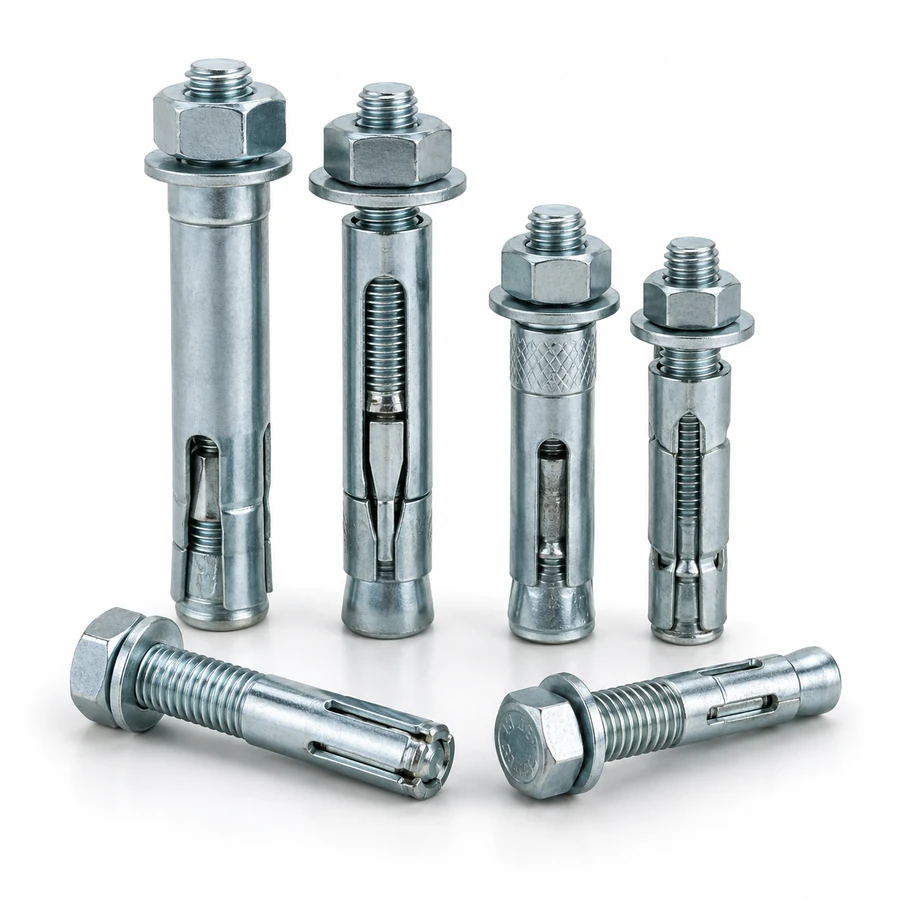
What is a drop-in anchor and how does it differ from a wedge or sleeve anchor?
A drop-in anchor is a female, internally threaded mechanical expansion anchor designed for flush-mount concrete fastening. It is set into a pre-drilled hole with a setting tool that expands the anchor against the base material. Unlike wedge anchors which use a wedge clip and sleeve anchors which expand along the sleeve, drop-in anchors require installation flush or slightly below the concrete surface and accept a separate male threaded fastener or stud. Base material suitability is product-specific and size-specific.
Can drop-in anchors be used in brick or masonry?
Drop-in anchors are primarily designed for use in concrete. Use in brick, block or masonry should be confirmed against the product-specific documentation and the buyer's project specifications. Not all drop-in anchors are suitable for all base materials. Anchor selection depends on base material, installation conditions, embedment depth, hole size, fixture thickness, spacing, edge distance and project requirements.
What setting tool is required for drop-in anchors?
Drop-in anchors require a specific setting tool matched to the anchor diameter. The setting tool is driven to expand the anchor against the hole wall. Using an incorrect or incompatible setting tool can affect anchor performance. The correct setting tool and installation procedure should be confirmed during manual RFQ review.
What head styles are available for drop-in anchors?
Drop-in anchors are by design flush-mount or slightly below-surface anchors. They do not have exposed head styles like wedge anchors (hex nut) or sleeve anchors (hex nut, hex bolt, flat head, hook, eye). Drop-in anchors accept a separate male threaded fastener (set screw, stud, bolt) that can have various head styles per the buyer's application requirements.
Can drop-in anchors be used for seismic applications?
Seismic suitability depends on the specific anchor product, size, base material, installation conditions and applicable evaluation documentation. No fixed seismic performance should be assumed without project-specific and product-specific confirmation. Test reports, approvals and load data are product-specific, size-specific, base-material-specific and installation-specific.
What are the standard materials for drop-in anchors?
Common materials include carbon steel with zinc plating for general indoor applications and stainless steel A2/304 or A4/316 for corrosion-resistant applications. Material selection depends on the service environment, base material and project specification. No fixed corrosion resistance or service life should be assumed without project-specific confirmation.
What is the correct hole size for a drop-in anchor?
Hole diameter and depth depend on the specific drop-in anchor diameter, design and product documentation. The hole must be drilled to the diameter and depth specified by the product manufacturer or applicable project specification. Hole dimensions derived from wedge or sleeve anchor documentation are not interchangeable. Confirm hole dimensions per the specific drop-in anchor product during RFQ review.
Can drop-in anchors be used with threaded rod?
Drop-in anchors are internally threaded and can accept threaded studs or bolts of the matching thread size and engagement length. The thread engagement, stud grade and length should be confirmed per the application requirements and project specification. Thread compatibility (metric or inch) must be confirmed — metric drop-in anchors are not compatible with inch-threaded fasteners.
How does the expansion mechanism of a drop-in anchor work?
A drop-in anchor consists of a female threaded body with an expansion cone and expander sleeve at the embedded end. When the setting tool is driven into the anchor, the expansion cone is forced downward, expanding the sleeve against the hole wall. This creates mechanical interlock with the base material. The exact expansion range and performance depend on the anchor design and product documentation.
Are drop-in anchors interchangeable with wedge anchors?
No. Drop-in anchors and wedge anchors have different designs, expansion mechanisms and installation methods. Drop-in anchors are female, flush-mount anchors set with a setting tool. Wedge anchors are male, through-anchors with a wedge clip and nut. They are not interchangeable. Product substitution must be confirmed by the buyer's qualified engineer or project documentation.
What inspection documents can be requested for drop-in anchors?
Depending on the item and buyer requirements, documents may include dimensional reports, thread inspection reports, material test certificates, coating thickness reports, packing lists, pre-shipment photos and applicable test documentation where available. Document requirements should be specified and confirmed during manual RFQ review.
Can drop-in anchors be used outdoors?
Outdoor use depends on the anchor material, finish, base material and service environment. Stainless steel drop-in anchors are commonly considered for outdoor or corrosive environments. No fixed corrosion resistance, UV resistance or service life should be assumed without project-specific confirmation.
Do all drop-in anchors have product-specific test reports or evaluations?
No. Product-specific test reports and evaluation documentation are product-specific, size-specific, base-material-specific and installation-specific. Not all drop-in anchors carry evaluation or ICC-ES/ETA reports. Buyers should confirm whether specific test documentation is required for their project during manual RFQ review.
Can load values be assumed from anchor diameter alone?
No. Load capacity depends on anchor diameter, embedment depth, base material and condition, edge distance, anchor spacing, load direction, installation quality and product-specific test data. No fixed load value should be assumed without project-specific confirmation.
How is the correct drop-in anchor size determined?
The correct drop-in anchor size depends on the application requirements including thread size required for the mating fastener, base material, fixture thickness, embedment depth, edge distance and anchor spacing requirements. Size selection should be confirmed by the buyer's qualified engineer or applicable project documentation.
Can website content substitute for engineering design or field verification?
No. Website content cannot substitute for project engineering design, valid test reports or field installation verification. Anchor selection and installation requirements must be confirmed by the buyer's qualified engineer or applicable project documentation.
Can you review a drop-in anchor RFQ that uses inch dimensions and convert it to metric references?
Reference conversions can be provided, but metric and inch drop-in anchors are not automatically interchangeable. The original dimensions, thread system, base material, embedment requirements and applicable project documentation must remain part of the RFQ review. See our Metric and Inch Fastener Conversion Guide for reference.
What affects the lead time for a drop-in anchor order?
Lead time depends on material availability, thread size, length, material, surface finish, heat treatment if applicable, coating, quantity, packing requirements, required documentation and inspection requirements. Final lead time is confirmed after RFQ review.