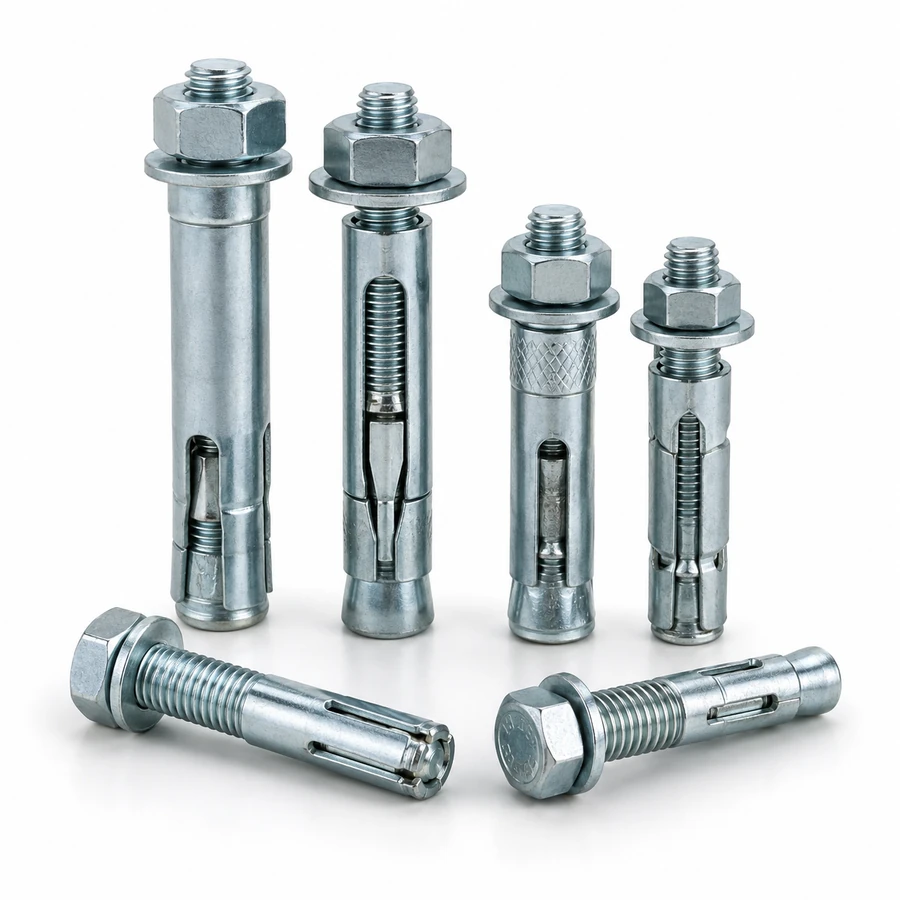
What is the difference between a wedge anchor and a sleeve anchor?
A wedge anchor uses a wedge clip that expands against the concrete wall when the nut is tightened, creating mechanical expansion along a single expansion zone. A sleeve anchor uses an expandable sleeve that expands around the bolt body. They use different expansion mechanisms, have different load-transfer characteristics and are not interchangeable. Buyers should confirm the specific anchor type per their project specification.
What is the difference between a wedge anchor and a drop-in anchor?
A wedge anchor is a through-bolt style anchor that passes through the fixture and is tightened with a nut from above. A drop-in anchor is an internally threaded flush anchor set inside the concrete with a setting tool, and a separate bolt is threaded into it after installation. They use different installation methods and serve different application requirements.
What is the difference between a wedge anchor and a concrete screw?
A wedge anchor is a mechanical expansion anchor that relies on an expansion clip wedged against the concrete. A concrete screw cuts its own thread into the concrete. They use different holding principles, have different removal characteristics and are not interchangeable. Buyers should confirm the specific anchor type per their application.
What is the difference between a wedge anchor and a chemical anchor?
A wedge anchor is a mechanical expansion anchor that achieves holding power through friction and keying of the expansion clip against concrete. A chemical anchor uses adhesive resin to bond the anchor to the concrete. They use different bonding principles, have different installation requirements and load characteristics. Buyers should confirm the specific anchor type per their project specification.
What is the difference between a wedge anchor and a cast-in anchor bolt?
A wedge anchor is a post-installed mechanical expansion anchor placed in a drilled hole in cured concrete. A cast-in anchor bolt is placed in wet concrete before pouring and becomes embedded as the concrete cures. They use different installation methods, have different load-transfer mechanisms and serve different project stages. They are not interchangeable.
Can wedge anchors be used in brick or hollow block?
Wedge anchors are designed for use in solid concrete base materials. They are not automatically suitable for brick, hollow block or unknown base materials. Using wedge anchors in incorrect base materials may result in anchor failure. Buyers should confirm the base material and anchor type per their project specification.
What information should buyers provide for a wedge anchor RFQ?
Buyers should provide anchor type, standard or evaluation reference, base material, concrete strength or project specification, cracked or uncracked concrete requirement, diameter, overall length, thread size, effective embedment depth, fixture thickness, hole diameter, hole depth, edge distance, anchor spacing, load direction, material, surface finish, nut and washer configuration, installation torque requirement, quantity by SKU, packing, inspection documents, required ETA/ESR or project documentation and destination.
Do all wedge anchors have an ETA or ICC-ES evaluation report?
No. Evaluation reports such as ETA or ICC-ES are product-specific, size-specific and installation-specific. Not all wedge anchors carry these evaluations. Buyers should confirm whether a specific evaluation report is required for their project and verify that the proposed product has the applicable approval.
Can installation torque be assumed from a product image or catalogue?
No. Installation torque depends on the anchor diameter, embedment depth, concrete strength, base material condition, fixture requirements and applicable evaluation report. Torque must be confirmed per the product-specific documentation and project requirements. Website content cannot substitute for the buyer's qualified engineer review.
Can load capacity be assumed from diameter alone?
No. Load capacity depends on anchor diameter, embedment depth, concrete strength, concrete condition (cracked or uncracked), edge distance, anchor spacing, load direction, installation quality and the applicable evaluation report. No fixed load value should be assumed without project-specific confirmation. Evaluation reports, approvals and load data are product-specific, size-specific and installation-specific.
What is the difference between full-thread and partial-thread wedge anchors?
A full-thread wedge anchor has threads along the exposed length above the embedment zone, allowing adjustable fixture height. A partial-thread wedge anchor has a fixed unthreaded section below the nut. The choice affects fixture thickness compatibility and clamping range. Buyers should confirm the thread configuration per their application requirements.
Why must effective embedment depth be confirmed?
Effective embedment depth directly affects anchor load capacity, expansion performance and concrete failure mode. Insufficient embedment may cause pull-out or concrete breakout. Excessive embedment may require deeper holes. Embedment depth must be confirmed per the applicable evaluation report and project specification.
What materials are commonly used for wedge anchors?
Common materials include carbon steel (zinc plated) for general indoor applications, and stainless steel A2/304 or A4/316 for corrosion-resistant applications. Material selection depends on the service environment, base material and project specification. Buyers should confirm the specific material per their application requirements.
Can wedge anchors be included in a mixed fastener order?
Yes. Mixed orders can be reviewed manually when anchor type, standard or evaluation reference, diameter, length, embedment, material, finish, nut and washer configuration, quantity, packing and inspection requirements are clear for each SKU.
What inspection documents can be discussed?
Depending on the item and buyer requirements, documents may include dimensional reports, material test certificates, coating thickness reports, packing lists, pre-shipment photos and applicable evaluation documentation where available.
What affects the lead time for a wedge anchor order?
Lead time depends on material availability, diameter, length, standard, heat treatment if applicable, coating, nut and washer configuration, quantity, packing requirements, required documentation and inspection requirements. Final lead time is confirmed after RFQ review.
Can website content substitute for structural engineering review?
No. Website content cannot substitute for structural engineering design, valid evaluation reports or field installation verification. Structural anchor selection and installation requirements must be confirmed by the buyer's qualified engineer or applicable project documentation.
Can you review a wedge anchor RFQ that uses inch dimensions and convert it to metric references?
Reference conversions can be provided, but metric and inch wedge anchors are not automatically interchangeable. The original thread system, dimensions, embedment requirements, matching components and applicable project documentation must remain part of the RFQ review. See our Metric and Inch Fastener Conversion Guide for reference.