
- Base material type
- Concrete strength
- Cracked or uncracked concrete
- Hole diameter
- Hole depth
- Hole cleaning
- Effective embedment depth
- Fixture thickness
- Edge distance
- Anchor spacing
- Installation torque
- Thread engagement
- Washer and nut configuration
- Static, wind, seismic or other project load requirements
- Indoor, outdoor or corrosive exposure
- Installation tool and procedure
- Qualified engineer or project approval
Fastener product knowledge
Wedge Anchors, Sleeve Anchors and Concrete Fastening Solutions
Concrete and structural anchors from China are commonly sourced for construction, infrastructure, and industrial fastening applications where secure fixing to concrete, masonry, or structural substrates is required. Common types include wedge anchors, sleeve anchors, drop-in anchors, anchor bolts, and expansion anchors. Buyers should confirm anchor type, diameter, overall length, embedment depth, thread size, material (carbon steel, stainless steel 304/316), and surface finish (zinc plating, hot-dip galvanizing, black oxide, or plain) before quotation. Standard references may include ASTM F1554, DIN 529, ICC-ES compliant designs, or project-specific drawings. We support sourcing communication for anchors with matching nuts and washers, mixed SKU orders, and Hebei / Yongnian fastener cluster sourcing where applicable. Prices, MOQ, delivery lead time, packing details, and documentation are confirmed after manual RFQ review. Product images are representative only; final specifications should be confirmed by buyer drawings, standards, samples, or purchase lists.
Direct Answer for Buyers
Wedge anchors, sleeve anchors, drop-in anchors, concrete screws, chemical anchors, cast-in anchor bolts and anchor rods are different products and cannot be identified from a product photo alone.
This page focuses on wedge anchors and sleeve anchors as the primary anchor types for concrete fastening applications.
To prepare an anchor RFQ, buyers should confirm at least:
- Anchor type
- Base material
- Cracked or uncracked concrete requirement
- Concrete strength or project specification
- Anchor diameter
- Overall length
- Thread size
- Effective embedment depth
- Fixture thickness
- Hole diameter
- Hole depth
- Edge distance
- Anchor spacing
- Required load direction
- Material
- Surface finish
- Installation torque where applicable
- Quantity by SKU
- Packing
- Required evaluation report or project approval
- Inspection document requirements
Prices, MOQ, packing, documentation, and lead time are confirmed after manual RFQ review.
Final specifications should be confirmed according to the buyer's drawing, BOM, project standard, installation conditions, or RFQ requirements.
Anchor selection and installation requirements must be confirmed by the buyer's qualified engineer or project specification where structural performance is involved.
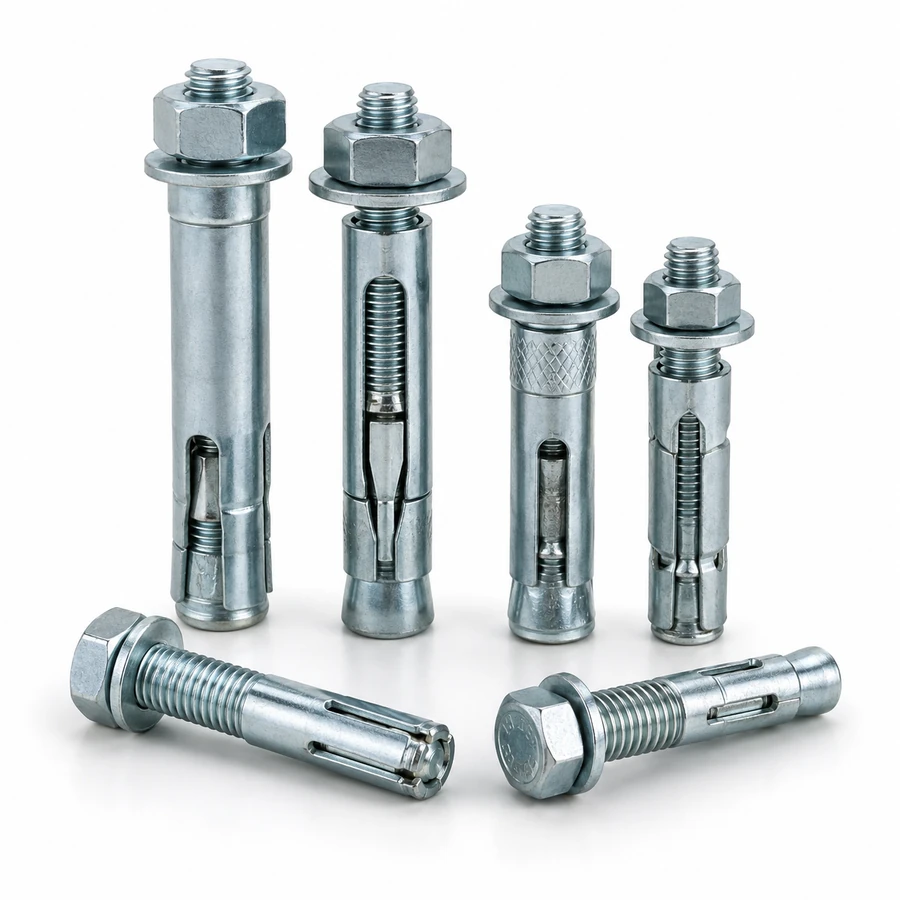
Product images are representative category references only. Final specifications should be confirmed by buyer drawings, standards, samples, or purchase lists.
Buyer Quick Answers
Short answers for commonly asked anchor sourcing questions.
1. What are concrete anchors?
Concrete anchors are fasteners designed to secure fixtures, structures, or equipment to concrete, masonry, or other base materials. They include wedge anchors, sleeve anchors, drop-in anchors, concrete screws, chemical anchors, cast-in anchor bolts, and anchor rods. Selection depends on base material, load conditions, installation method, and project specifications.
2. Wedge anchors vs sleeve anchors: what is the difference?
Wedge anchors work through mechanical expansion. The concrete types and conditions in which a specific product may be used must follow the applicable product approval, manufacturer data, and project requirements. Sleeve anchors have a cylindrical sleeve that expands against the base material and may also be used in brick or block depending on the design. They are not interchangeable products.
3. Drop-in anchors vs wedge anchors: how should buyers choose?
Most internally threaded drop-in anchors are expanded with a specified setting tool, but hole diameter, depth, cleaning, and setting must follow the applicable product approval, manufacturer instructions, and project requirements. Wedge anchors are externally threaded expansion anchors that wedge against the base material. The choice depends on the mating bolt requirement, installation access, base material, embedment depth, and project standard.
4. Anchor bolts vs expansion anchors: what is the difference?
Anchor bolt is a broad term that may include cast-in anchor bolts, expansion anchors, chemical anchors and anchor rods. Expansion anchors such as wedge anchors and sleeve anchors achieve retention through mechanical expansion against the base material after installation. Different products within the anchor bolt category are not interchangeable.
5. Mechanical anchors vs chemical anchors: what should buyers know?
Mechanical anchors such as wedge anchors and sleeve anchors achieve retention through expansion against the base material. Chemical anchors use resin or adhesive systems to bond an anchor rod inside the hole. Bonded anchors must satisfy the specified curing time. When a mechanical anchor may be loaded depends on completed installation, required torque, the applicable product approval, manufacturer instructions, and project requirements. Selection depends on base material, load type, temperature, and project requirements.
6. What information is required to select a concrete anchor?
Anchor selection requires base material type and strength, cracked or uncracked concrete condition, anchor type, diameter, overall length, effective embedment depth, fixture thickness, hole diameter, edge distance, anchor spacing, load direction, material, finish, and applicable project standard or evaluation report requirements.
7. Metric anchors vs inch anchors: can they be interchangeable?
No. Metric and inch anchors are not automatically interchangeable. The diameter, thread system, dimensional ranges, and applicable fastener standards differ between the two systems. Buyers should confirm the original specification. See the Metric and Inch Fastener Conversion Guide for reference.
8. Carbon steel anchors vs stainless steel anchors: what is the difference?
Carbon steel anchors are commonly selected for general-purpose anchoring but require a surface finish for corrosion protection. Stainless steel anchors (e.g. A2/304 or A4/316) are typically chosen where corrosion resistance is needed and may be evaluated under applicable evaluation reports for the specific anchor design.
9. Zinc plated vs hot dip galvanized anchors: what should buyers know?
Zinc-plating performance must be assessed by coating system, thickness, and exposure conditions; it is not a general guarantee for indoor or light outdoor use. Hot-dip galvanizing usually produces a thicker coating, but permitted use, thread fit, and corrosion life must follow the applicable standard, product approval, manufacturer data, and project requirements.
10. What information is required for an anchor RFQ?
A complete anchor RFQ should include anchor type, standard or evaluation reference, base material, diameter, overall length, thread size, effective embedment depth, fixture thickness, hole diameter, edge distance, spacing, material, finish, quantity, packing requirements, mating nut and washer details where applicable, and required project documentation.
11. Can anchors be included in mixed fastener orders?
Yes. Anchors can be included in mixed fastener orders when each SKU has a clear anchor type, base material, diameter, length, thread, material, finish, quantity, and packing requirement. Anchor items should specify embedment depth, hole diameter, and fixture thickness where applicable.
12. How can buyers source anchors from China?
Buyers can submit a drawing, BOM, or itemised RFQ with anchor type, standard or evaluation reference, base material, diameter, length, embedment depth, thread, material, finish, quantity, and packing details. Prices, MOQ, packing, documentation and lead time are confirmed after manual RFQ review.
Anchor Types and Applications
Use this table as a starting point for RFQ preparation. Wedge anchors and sleeve anchors are different products and should not be treated as interchangeable based on appearance alone. Final specifications should come from buyer documents.
| Anchor Type | Typical Application | RFQ Detail to Confirm | Buyer Note |
|---|---|---|---|
| Wedge anchors | Mechanical expansion anchoring in concrete | Concrete condition, diameter, length, embedment, fixture thickness, hole diameter, installation torque | Primarily for solid concrete. Not designed for brick or hollow block. |
| Sleeve anchors | Concrete, brick or masonry applications per buyer specification | Base material, diameter, sleeve type, length, embedment, hole diameter | Base material must be confirmed. Load data cannot be transferred between different substrates. |
| Drop-in anchors | Internal-threaded anchor for concrete | Mating bolt, installation tool, hole diameter, embedment depth | Requires setting tool for proper installation. |
| Concrete screws | Threaded fastening into pre-drilled holes in concrete | Hole diameter, hole depth, repeated installation requirement, base material condition | Requires proper drill bit size and installation procedure. |
| Chemical anchors | Resin or adhesive anchoring systems | Adhesive system, anchor rod, hole cleaning procedure, temperature and curing requirements | Installation procedure and hole cleaning significantly affect performance. |
| Cast-in anchor bolts | Placed before concrete pour per buyer specification | Location, projection, thread specification, material grade | Not an expansion anchor. Position is fixed before concrete is placed. |
| Anchor rods | Embedded or post-installed anchor systems per buyer design | Material grade, thread specification, mating system, project drawing | Often specified under ASTM F1554 or project standard. |
| Specialty anchors made to drawing | Project-specific anchor designs per buyer specification | Drawing, sample, project standard, applicable evaluation report | Final dimensions, material and finish per buyer documents. |
Important: Wedge anchors and sleeve anchors cannot be interchanged because they appear similar. Concrete, solid brick, hollow brick, block and stone are not the same base materials. Product images are reference only and do not replace complete specifications.
Standards, Testing and Approval References
The following references apply to specific anchor types, materials, installations and evaluation contexts. Not every anchor product automatically complies with every reference below. Buyers should confirm which standard or evaluation document applies to their specific anchor product and project requirements.
| Reference | Scope | When Buyers May Request It | Important Limitation |
|---|---|---|---|
| EAD 330232-01-0601 | Mechanical fasteners for use in concrete (European assessment) | When ETA for mechanical anchors is required for European project specifications | Only applicable to specific products with a valid ETA. Not a general product dimension standard. |
| ASTM E488 / E488M | Standard test methods for strength of anchors in concrete elements | When test methodology reference is needed for anchor evaluation | A test method, not a product compliance certification. Does not automatically apply to all anchors. |
| ICC-ES Evaluation Report / ESR | Evaluation of specific products and systems (US) | When ICC-ES report is required for US project approval | Must confirm exact product model, report number, applicable base materials and valid scope. One product's ESR cannot be used for another product. |
| European Technical Assessment / ETA | Technical assessment for specific products (Europe) | When ETA is required for European project specifications | Must match exact ETA number, product design, materials, diameter range and installation conditions. Not all anchors have an ETA. |
| ASTM F1554 | Anchor bolts and anchor rods for structural applications | When anchor rods or cast-in bolts are specified per ASTM F1554 grades | Applies to specific steel anchor bolts and rods. Does not apply to mechanical expansion anchors such as wedge anchors or sleeve anchors. |
| Buyer drawing or project specification | Non-standard or project-specific anchor designs | When standard products do not match project requirements | Final dimensions, material, finish and performance per buyer project documents. |
Important: Evaluation reports, approvals and load data are product-specific and installation-specific. They must not be transferred from one anchor design, material, diameter or base material to another.
Materials and Surface Finish Directions
Material and finish must be reviewed together with the base material, exposure class, anchor design and installation conditions. The final choice depends on project requirements and buyer specifications.
| Material / Finish | Typical Direction | RFQ Detail to Confirm | Buyer Note |
|---|---|---|---|
| Carbon steel, zinc plated | General interior environment per buyer specification | Coating colour, thickness, corrosion resistance requirement | Not suitable for all outdoor or corrosive environments. |
| Carbon steel, yellow zinc plated | Standard finish for identification and appearance | Coating system, colour requirement, thickness specification | Colour and coating system must be defined in RFQ. Not identifiable from image alone. |
| Hot-dip galvanized steel | Corrosion-prone environment per buyer specification | Dimensions, thread fit, coating thickness, product geometry suitability | Thread fit and coating thickness must be confirmed for each anchor design. |
| Zinc flake coated steel | Corrosion and friction performance per buyer specification | Coating system, test requirement, friction class if applicable | Coating system and performance requirements must be specified. |
| Stainless steel A2 / 304 | General corrosion-resistant applications | Grade confirmation, application environment | Not automatically suitable for all corrosive environments including marine exposure. |
| Stainless steel A4 / 316 | Higher corrosion resistance environment | Grade confirmation, project standard, exposure condition | Final choice depends on project environment and buyer standard. |
| Buyer-specified special material or coating | Project-specific or non-standard requirements | Project standard, drawing, RFQ specification | Final confirmation per buyer documents. |
Important: Material and finish must be reviewed together with the base material, exposure class, anchor design and installation conditions. The presence of hydrogen embrittlement risk should be evaluated per product material, hardness, coating system and buyer standard where applicable. General guarantees about outdoor service life, salt spray hours or corrosion resistance cannot be provided without project-specific information.
Installation and Mechanical Considerations
The following parameters affect anchor performance and must be confirmed against the buyer's project design or applicable evaluation documentation. Load capacity is not determined by anchor diameter alone.
Important: Load capacity depends on base material, embedment depth, edge distance, spacing, hole quality, installation torque and installation method in addition to anchor diameter. Guaranteed load data cannot be provided without the buyer's project information. Test data from one manufacturer, one anchor model or one diameter cannot be applied to another anchor product. Structural anchor selection should be verified against the buyer's project design and applicable evaluation documentation.
Anchors RFQ Checklist
Use this checklist when preparing an anchor RFQ. Different diameters, lengths, materials, surface finishes and anchor types must be separated into individual SKU lines.
- Anchor type
- Standard, drawing or evaluation reference
- Base material
- Concrete strength
- Cracked or uncracked concrete requirement
- Diameter
- Overall length
- Thread size
- Effective embedment depth
- Fixture thickness
- Hole diameter
- Hole depth
- Edge distance
- Anchor spacing
- Required load direction
- Required design or test load information
- Carbon steel or stainless steel
- Stainless steel grade
- Surface finish
- Coating requirement
- Nut and washer configuration
- Installation torque
- Installation tool
- Quantity by SKU
- Packing quantity
- Carton and pallet requirements
- Label requirements
- Inspection document requirements
- Required ETA, ESR or project documentation
- Destination country or port
- Drawing, BOM, sample or project specification
Different diameters, lengths, materials, surface finishes and anchor types must be separated into individual SKU lines.
Common Procurement Mistakes
- Calling every concrete fastener an "anchor bolt".
- Confusing wedge anchors with sleeve anchors.
- Identifying an anchor only from a photograph.
- Not specifying the base material.
- Assuming concrete, brick and hollow block use the same anchor data.
- Ignoring cracked or uncracked concrete requirements.
- Not confirming fixture thickness.
- Ignoring embedment depth.
- Ignoring hole diameter and hole depth.
- Ignoring edge distance and anchor spacing.
- Selecting products only by diameter.
- Copying load data from another manufacturer or another anchor size.
- Treating ASTM F1554 anchor rods as mechanical expansion anchors.
- Claiming ETA or ICC-ES approval without confirming the exact product and report.
- Ignoring installation torque.
- Ignoring hole cleaning and installation procedure.
- Mixing different diameters, lengths or finishes in one unclear RFQ line.
- Approving structural anchors only from a representative image.
Anchors FAQ
Short answers for buyers preparing technical anchor RFQs.
What is the difference between wedge anchors and sleeve anchors?
Wedge anchors work through mechanical expansion. The concrete types and conditions in which a specific product may be used must follow the applicable product approval, manufacturer data, and project requirements. Sleeve anchors have a cylindrical sleeve that expands against the base material and may also be used in brick or block depending on the design. They are not interchangeable products.
Can wedge anchors be used in brick or hollow block?
Wedge anchors are designed primarily for solid concrete. Brick, hollow block and other masonry materials require different anchor designs and installation procedures. Base material must be confirmed before anchor selection.
What information should buyers provide for an anchor RFQ?
Buyers should provide anchor type, standard or drawing reference, base material, diameter, overall length, thread size, effective embedment depth, fixture thickness, hole diameter, finish, quantity, packing and inspection document requirements.
Why must buyers specify the base material?
Concrete, solid brick, hollow brick, block and stone are not the same base materials. Anchor performance and installation depend on the base material. The same anchor cannot automatically be used in different base materials.
What is effective embedment depth?
Effective embedment depth is the distance from the surface of the base material to the deepest point of the anchor engagement. It affects load capacity and must be specified rather than assumed from overall length.
Why are edge distance and anchor spacing important?
Edge distance and anchor spacing directly affect load capacity, concrete breakout resistance and installation safety. These parameters must be confirmed against the project design or applicable evaluation documentation.
Can anchor load data be selected only by diameter?
No. Load capacity depends on embedment depth, base material strength, edge distance, spacing, installation quality and the specific anchor design. Diameter alone is not sufficient to determine load performance.
What is the difference between an anchor bolt and a mechanical expansion anchor?
Anchor bolt is a broad term that may include cast-in anchor bolts, expansion anchors, chemical anchors and anchor rods. Mechanical expansion anchors like wedge anchors and sleeve anchors achieve retention through expansion against the base material. Different products within the anchor bolt category are not interchangeable.
Does every wedge anchor have ETA or ICC-ES approval?
No. ETA or ICC-ES approval applies only to specific products with valid evaluation reports. Buyers should confirm the exact product, report number, materials, diameters and installation conditions when approval is required.
Which materials and finishes are suitable for outdoor anchor applications?
Hot-dip galvanized or stainless steel anchors are commonly discussed for outdoor or corrosion-prone environments. The final material and finish choice should be confirmed against the project specification, exposure class and applicable evaluation documentation.
Can wedge anchors and sleeve anchors be included in one mixed order?
Yes. Mixed orders can be reviewed manually when SKU data, diameters, lengths, materials, finishes, quantities, packing and inspection requirements are clear for each anchor type.
What affects the lead time for a mixed anchor order from China?
Lead time depends on material availability, finish processing, quantity, packing complexity and inspection requirements. Final lead time is confirmed after RFQ review.
What are concrete anchors?
Concrete anchors are fasteners designed to secure fixtures, structures, or equipment to concrete, masonry, or other base materials. They include wedge anchors, sleeve anchors, drop-in anchors, concrete screws, chemical anchors, cast-in anchor bolts, and anchor rods. Selection depends on base material, load conditions, installation method, and project specifications.
Metric anchors vs inch anchors: can they be interchangeable?
No. Metric and inch anchors are not automatically interchangeable. The diameter, thread system, dimensional ranges, and applicable fastener standards differ between the two systems. Buyers should confirm the original specification. See the Metric and Inch Fastener Conversion Guide for reference.
Drop-in anchors vs wedge anchors: how should buyers choose?
Most internally threaded drop-in anchors are expanded with a specified setting tool, but hole diameter, depth, cleaning, and setting must follow the applicable product approval, manufacturer instructions, and project requirements. Wedge anchors are externally threaded expansion anchors that wedge against the base material. The choice depends on the mating bolt requirement, installation access, base material, embedment depth, and project standard.
Mechanical anchors vs chemical anchors: what should buyers know?
Mechanical anchors such as wedge anchors and sleeve anchors achieve retention through expansion against the base material. Chemical anchors use resin or adhesive systems to bond an anchor rod inside the hole. Bonded anchors must satisfy the specified curing time. When a mechanical anchor may be loaded depends on completed installation, required torque, the applicable product approval, manufacturer instructions, and project requirements. Selection depends on base material, load type, temperature, and project requirements.
Related Sourcing Links
Use these pages with the anchor reference when preparing a buyer RFQ or mixed fastener list.
Send Anchor RFQ for Manual Review
Share anchor types, drawings, standards, quantities, finish requirements, packing expectations, and inspection document needs for manual review.
Send RFQEmail: xyan060816@gmail.com