
Screws
China sourcing support for machine screws, self-tapping screws, self-drilling screws, wood screws and related industrial screw types. Final product selection depends on the buyer's drawing, dimensions, thread type, material, finish, application, and applicable standard.
Product Overview
This page covers machine screws, self-tapping screws, self-drilling screws, wood screws, chipboard screws, drywall screws, socket screws, hex washer head screws, and custom drawing screws.
Products that differ by screw type, diameter, length, thread, head, drive, point, material, or finish should be listed as separate RFQ line items.
Final specifications must be confirmed against the buyer's drawing, BOM, project standard, sample, or purchasing requirement.
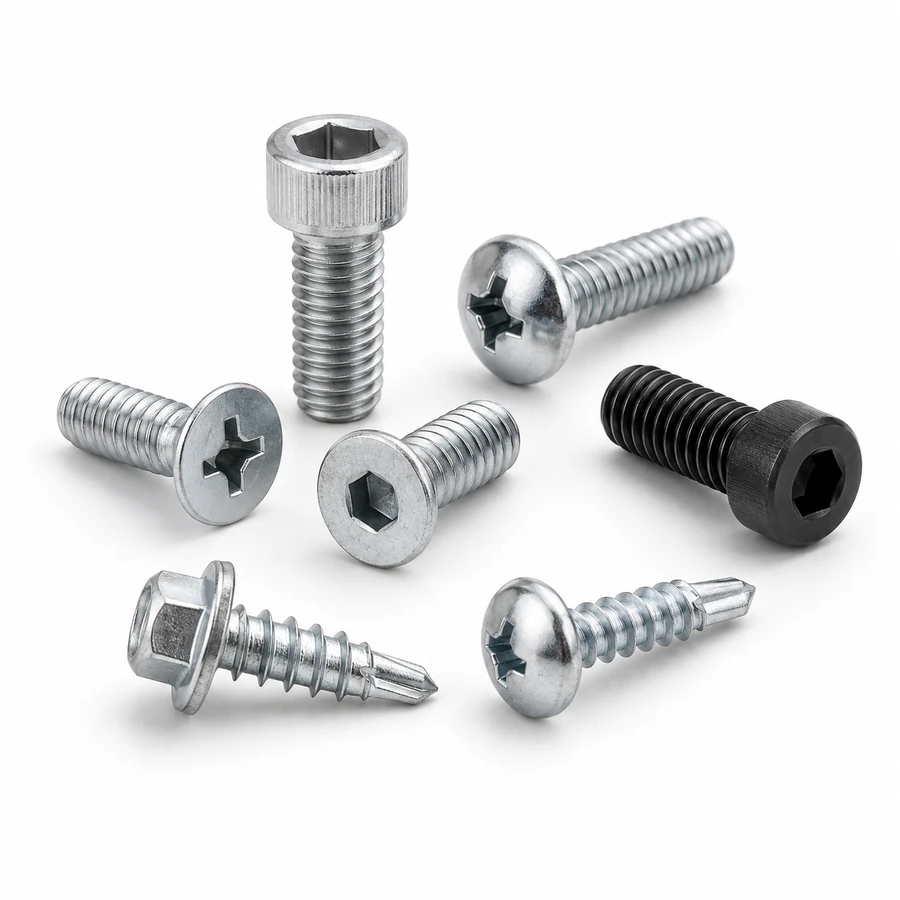
Representative category image only. It does not define the final specification.
Buyer Quick Answers
Short answers for commonly asked screw sourcing questions.
1. What are industrial screws?
Industrial screws are threaded fasteners designed for a range of assembly applications including machinery, construction, metalworking, woodworking, and manufactured products. They are specified by type, standard, thread, head, drive, point, material, finish, and dimensional requirements.
2. Machine screws vs self-tapping screws: what is the difference?
Machine screws are designed for use with tapped holes or mating nuts and have uniform machine threads. Self-tapping screws form or cut their own mating threads in a prepared substrate and may require a pilot hole. The selection depends on the substrate, standard, and assembly requirements.
3. Self-tapping screws vs self-drilling screws: what is the difference?
Self-tapping screws form or cut mating threads and commonly require a prepared pilot hole. Self-drilling screws include a drill point intended to create a hole before thread engagement. Selection depends on substrate material, thickness, point design, and installation conditions.
4. What are socket head cap screws used for?
Socket head cap screws are commonly used in machinery, tooling, and equipment assemblies where a recessed hex drive is required. They are typically specified by standard (e.g. DIN 912 or ISO 4762), diameter, length, material, and property class.
5. Metric screws vs inch screws: can they be interchangeable?
No. Metric and inch screws are not automatically interchangeable. The thread pitch or TPI, diameter, and dimensional system differ between the two. Buyers should confirm the original specification. See the Metric and Inch Fastener Conversion Guide for reference.
6. How do screw thread types affect selection?
Screw thread type affects the assembly method and application. Machine threads require tapped holes or nuts, self-tapping threads form mating threads in a substrate, and self-drilling points both drill and tap in one step. Buyers should confirm thread type by the applicable standard, substrate material, and installation method.
7. Phillips, hex socket and Torx drive types: how to choose?
The drive type should be selected based on installation tooling, torque requirements, and cam-out risk. Phillips drives are common for general assembly. Hex socket drives are typical for machinery. Torx drives offer increased torque transfer and reduced cam-out. The appropriate drive should be confirmed by the applicable standard or drawing.
8. Carbon steel screws vs stainless steel screws: what is the difference?
Carbon steel screws are commonly selected for general-purpose fastening but require a surface finish for corrosion protection. Stainless steel screws are typically chosen where corrosion resistance is needed. Buyers should confirm the exact material grade (e.g. A2/304 or A4/316) and whether a plated or passivated finish is required.
9. Zinc plated vs other surface finishes for screws: what should buyers know?
Zinc plating provides a common level of corrosion protection for indoor or light outdoor applications. Black oxide and black phosphate are typically used for appearance or oil-holding purposes. Nickel plating offers a different appearance. The finish should be reviewed with the screw type, application environment, and project specification.
10. What information is required for a screw RFQ?
A complete screw RFQ should include screw type, standard or drawing, diameter, length, thread type, head type, drive type, point type, material, mechanical requirement, surface finish, quantity, packing requirements, and inspection document requirements.
11. Can screws be included in mixed fastener orders?
Yes. Screws can be included in mixed fastener orders when each SKU has a clear screw type, standard or drawing, diameter, length, thread, head, drive, point, material, finish, quantity, and packing requirement. Mixed orders should list screws separately from bolts, nuts, washers, and other fasteners.
12. How can buyers source screws from China?
Buyers can submit a drawing, BOM, or itemised RFQ with screw type, standard, diameter, length, thread, head, drive, point, material, finish, quantity, and packing details. Prices, MOQ, packing, documentation and lead time are confirmed after manual RFQ review.
Common Screw Types
Head and Drive Options
Available head and drive combinations depend on screw type, diameter, length, and production standard.
| Category | Common options | RFQ confirmation |
|---|---|---|
| Head types | Pan, flat / countersunk, truss, round, hex washer, socket | Confirm head dimensions, bearing surface, and installation clearance. |
| Drive types | Phillips, Pozidriv, slotted, Torx, hex socket, combination | Confirm recess standard, tool fit, torque, and appearance requirements. |
Threads and Points
| Thread or point | Reference description | Selection note |
|---|---|---|
| Machine thread | Uniform thread for a tapped hole or nut | Confirm metric or inch system, pitch, and tolerance. |
| Self-tapping thread | Forms or cuts a mating thread | Confirm pilot hole, substrate, and thread-forming or cutting design. |
| Self-drilling point | Integrated drill point before thread engagement | Confirm substrate material, thickness, and drilling capacity. |
| Wood / chipboard thread | Deep thread for timber or engineered wood | Confirm application material and splitting risk. |
| Fine / coarse thread | Different thread density and engagement behavior | Do not substitute without application and standard review. |
Common Standards
Standards, dimensions, and tolerances must be confirmed against the buyer's drawing, BOM, project specification, or RFQ.
| Reference | Typical description |
|---|---|
| DIN 84 / DIN 85 | Slotted cheese head / pan head machine screw references |
| DIN 963 / DIN 965 | Slotted / cross-recessed countersunk screw references |
| ISO 7045 / ISO 7046 | Cross-recessed pan head / countersunk screw references |
| ISO 7049 / ISO 7050 | Cross-recessed tapping screw references |
| ANSI / ASME B18.6.3 | Inch machine screw and tapping screw reference |
Materials
- Carbon Steel
- Stainless Steel 304
- Stainless Steel 316
- Alloy Steel
- Brass
Material availability depends on screw type, size, mechanical requirements, and order review.
Finishes
- Zinc Plated
- Yellow Zinc Plated
- Black Oxide
- Black Phosphate
- Nickel Plated
- Stainless Steel Passivation
- Other project-specified coatings
Not every finish is suitable or available for every screw type or application.
Screws RFQ Checklist
- Screw Type
- Applicable Standard or Drawing
- Diameter
- Length
- Thread Type
- Head Type
- Drive Type
- Point Type
- Material
- Grade or Mechanical Requirement
- Surface Finish
- Quantity
- Packing Requirement
- Inspection or Documentation Requirement
- Destination Country or Port
Manual Review Notice
Prices, MOQ, packing, documentation, and lead time are confirmed after manual review of the RFQ.
Final specifications must be confirmed against the buyer's drawing, BOM, project standard, or purchasing requirement.
Screws FAQ
What information is required for a screw RFQ?
Provide the screw type, applicable standard or drawing, diameter, length, thread, head, drive, point, material, mechanical requirement, finish, quantity, packing, documentation, and destination. Application and substrate details are also useful for review.
Can screws be supplied according to drawings?
Custom drawing screws can be reviewed when the drawing clearly defines dimensions, tolerances, material, mechanical properties, finish, inspection criteria, and order quantity. Feasibility is confirmed during manual RFQ review.
What is the difference between self-tapping and self-drilling screws?
Self-tapping screws form or cut mating threads and commonly require a prepared pilot hole. Self-drilling screws include a drill point intended to create a hole before thread engagement. Selection depends on substrate material, thickness, point design, and installation conditions.
Which materials and finishes are commonly available?
Common directions include carbon steel, stainless steel 304 or 316, alloy steel, and brass, with zinc plating, black oxide, black phosphate, nickel plating, passivation, or project-specified coatings. Availability and suitability depend on the exact screw specification.
Can head and drive combinations be customized?
Head and drive combinations may be reviewed for standard or drawing-based screws. Availability depends on screw type, diameter, length, tooling, production standard, quantity, and mechanical requirements.
What inspection documents can be discussed during RFQ review?
Depending on the item and buyer requirements, dimensional reports, material certificates, coating thickness reports, hardness tests, thread checks, drilling or tapping performance records, packing lists, and pre-shipment inspection evidence may be discussed.
What are industrial screws?
Industrial screws are threaded fasteners designed for a range of assembly applications including machinery, construction, metalworking, woodworking, and manufactured products. They are specified by type, standard, thread, head, drive, point, material, finish, and dimensional requirements.
Machine screws vs self-tapping screws: what is the difference?
Machine screws are designed for use with tapped holes or mating nuts and have uniform machine threads. Self-tapping screws form or cut their own mating threads in a prepared substrate and may require a pilot hole. The selection depends on the substrate, standard, and assembly requirements.
What are socket head cap screws used for?
Socket head cap screws are commonly used in machinery, tooling, and equipment assemblies where a recessed hex drive is required. They are typically specified by standard (e.g. DIN 912 or ISO 4762), diameter, length, material, and property class.
Metric screws vs inch screws: can they be interchangeable?
No. Metric and inch screws are not automatically interchangeable. The thread pitch or TPI, diameter, and dimensional system differ between the two. Buyers should confirm the original specification. See the Metric and Inch Fastener Conversion Guide for reference.
How do screw thread types affect selection?
Screw thread type affects the assembly method and application. Machine threads require tapped holes or nuts, self-tapping threads form mating threads in a substrate, and self-drilling points both drill and tap in one step. Buyers should confirm thread type by the applicable standard, substrate material, and installation method.
Carbon steel screws vs stainless steel screws: what is the difference?
Carbon steel screws are commonly selected for general-purpose fastening but require a surface finish for corrosion protection. Stainless steel screws are typically chosen where corrosion resistance is needed. Buyers should confirm the exact material grade (e.g. A2/304 or A4/316) and whether a plated or passivated finish is required.
Zinc plated vs other surface finishes for screws: what should buyers know?
Zinc plating provides a common level of corrosion protection for indoor or light outdoor applications. Black oxide and black phosphate are typically used for appearance or oil-holding purposes. Nickel plating offers a different appearance. The finish should be reviewed with the screw type, application environment, and project specification.
Can metric and inch screws be substituted?
No. Metric and inch screws are not automatically interchangeable. The thread profile, diameter, pitch or TPI, head dimensions, and drive specifications differ between the two systems. Buyers should confirm the original specification. See the Metric and Inch Fastener Conversion Guide for reference.
Can screws be included in mixed fastener orders?
Yes. Screws can be included in mixed fastener orders when each SKU has a clear screw type, standard or drawing, diameter, length, thread, head, drive, point, material, finish, quantity, and packing requirement. Mixed orders should list screws separately from bolts, nuts, washers, and other fasteners.
How can buyers source screws from China?
Buyers can submit a drawing, BOM, or itemised RFQ with screw type, standard, diameter, length, thread, head, drive, point, material, finish, quantity, and packing details. Prices, MOQ, packing, documentation and lead time are confirmed after manual RFQ review.
Related Sourcing Links
Use these pages with the screw reference when preparing a buyer RFQ or mixed fastener list.
Send Screws RFQ for Manual Review
Share drawings, standards, dimensions, materials, finishes, quantities, packing, and documentation requirements.
Send RFQ